
Wandering Eyes
-
Posts
132,492 -
Joined
-
Last visited
-
Days Won
2
1 Follower

Wandering Eyes's Achievements






-
 The catalogue for the inaugural Inglis Digital USA GI Curlin Florida Derby Sale is now online, offering buyers the chance to participate on the Mar. 28 marquee card of Gulfstream Park's Championship Meet. Bidding will be open through Mar. 23, with the first lot closing at 3 p.m. ET. Sellers with horses entered on the Florida Derby day card will be able to supplement them into the auction for full or percentage sales. Among the entries in the Curlin Florida Derby Sale is Lightning Tones (Tonalist), who is being pointed for the GIII Ghostzapper Stakes on the Florida Derby undercard. The two-time winner of the Sunshine Classic Stakes is consigned by Paramount Sales and is available for inspection out of the barn of owner/trainer Jose Castro at Palm Meadows Training Center. Also on offer at the digital sale is a 49% stake in allowance winner Ababajoni (Neolithic), who will aim for the Cutler Bay Stakes on the Florida Derby undercard after going gate-to-wire to win a Gulfstream Park turf allowance Mar. 6. Ababajoni is offered by owner/trainer Rohan Crichton and is available for inspection in Crichton's barn at Gulfstream Park. Also in the catalogue is Mar. 14 Hutcheson Stakes winner Fulmine (Spun to Run) and Quereme Pass (Arg) (Distinctiv Passion), who was second in the GIII San Simeon Stakes that same day. Fulmine is consigned by owner Starry Night Racing and may be inspected at the Palm Meadows barn of trainer J. Kent Sweezey, while Quereme Pass is offered by trainer Jose D'Angelo, agent, and is available for inspection at Palm Meadows. Rounding out the racing prospects in the sale is the 3-year-old filly La Chismosa (Win Win Win), who has won three of her past four starts. Offered by owner Paula Capestro Bloodstock, La Chismosa may be inspected at Tampa Bay Downs. “This boutique sale offers quality with every horse,” said Inglis Digital USA CEO Kyle Wilson. “You have the potential opportunity to be an owner on GI Florida Derby day. How special is that?” All ownership changes for horses entered on the Florida Derby card can be made by race day with the assistance of Gulfstream Park. The horse must stay in the race with the trainer who entered them, but the new owner is free to choose their own trainer afterward. Buyers of horses entered in upcoming races must already have or obtain a valid Florida Racing License prior to the race. Interested parties must register for an account on the Inglis Digital USA website, www.inglisdigitalusa.com, and request a bidding limit in order to place bids. The post Bidding Open for Inglis Digital USA Curlin Florida Derby Sale appeared first on TDN | Thoroughbred Daily News | Horse Racing News, Results and Video | Thoroughbred Breeding and Auctions. View the full article
 -
Stakes winner Saint Martin (Time Test) (lot 4) has been added to Arqana Online's March Sale. The sale will take place between 3-5 p.m. French time on March 25. The Christophe Escuder-trained colt has won three of his four starts, including last weekend's Listed Prix Francois Mathet. He is rated 101 and holds an entry in the G1 Grand Prix de Paris at ParisLongchamp on July 14. The three-year-old is out of listed winner Abraxa (Verglas), who placed in the G3 Grosser Preis der Mehl-Mulhens-Stiftung in Germany. He is also a half-brother to four winners so far. This is the extended family of GIII Florida Oaks heroine Outburst (Outstrip) and dual graded scorer Duboff (So Blessed). The post Stakes Winner Added To Arqana Online March Sale appeared first on TDN | Thoroughbred Daily News | Horse Racing News, Results and Video | Thoroughbred Breeding and Auctions. View the full article
-
Reigning Japanese Horse of the Year Forever Young (Real Steel) is one of nine horses declared for the $12-million G1 Dubai World Cup at Meydan on March 28. Several horses originally pointing toward the meeting have opted to skip it for different targets as the conflict in Iran has escalated. Yoshito Yahagi's star is joined by 2025 winner Hit Show (Candy Ride), Grade II winner Magnitude (Not This Time), and fellow top level winners Walk Of Stars (Dubawi) and Imperial Emperor (Dubawi). For the G1 Dubai Sheema Classic, Calandagan (Gleneagles) anchors the seven possible runners, having last won the G1 Japan Cup. Both nine-time Group/Grade 1 winner Rebel's Romance (Dubawi) and Ethical Diamond (Awtaad) are also signed on. Top flight winners set for the G1 Dubai Turf include multiple Group 1 winner Ombudsman (Night Of Thunder), as well as Queen Anne Stakes hero Docklands (Massaat) and the 2024 winner Facteur Cheval (Ribchester). The 2025 GI Breeders' Cup Sprint victor Bentornato (Valiant Minister) faces Tuz (Oxbow), in the G1 Dubai Golden Shaheen, with the latter taking the 2024 edition. In the G1 Al Quoz Sprint, Lazzat (Territories) and Khaadem (Dark Angel) square off. “We are delighted to see horses from so many different countries here for this landmark 30th Dubai World Cup meeting,” said Erwan Charpy, head of department, racing operations & international relations, for Dubai Racing Club. “To have so many defending and former champions, including Hit Show, Rebel's Romance, Tuz, Forever Young and Dark Saffron back here is also very pleasing. We thank everyone for their support and wish them the best of luck on the big day.” The first post for next Saturday's $30.5-million card begins at 3:45 p.m., UAE time. For the likely fields, please click here. The post Forever Young Highlights Likely Dubai World Cup Night Fields appeared first on TDN | Thoroughbred Daily News | Horse Racing News, Results and Video | Thoroughbred Breeding and Auctions. View the full article
-
A Kentucky Derby prep race could be next for Crude Velocity (Beau Liam), who overcame an impossible trip to win on debut with 'TDN Rising Star, presented by Hagyard' honors for Bob Baffert at Santa Anita Mar. 7. “We're gonna leave California with him,” owner Bill Childs said after reloading at last week's OBS March sale. “There are more opportunities for him outside of California. Bob will still have him. We want to take dead aim on what we're doing being something worthwhile. We're gonna try to target something that won't be easy, but we feel like we have one that fits that plan.” Nothing went according to plan for Crude Velocity first time out. Overlooked at odds of 10-1, the bay was off to a slow start from his rail draw and trailed the field of nine shortly after the break in a very deep 6 1/2-furlong maiden special weight. He rushed up and raced under a tight hold beneath Florent Geroux just behind the leaders in sixth through an opening quarter in :22.23. Steadied in traffic, Crude Velocity dropped back sharply and was going the wrong way around the far turn. He wasn't done yet though. He dialed it back up approaching the quarter pole, was guided out into the clear in the stretch and came storming home in a field-best :30.64 to nail the GII Wood Memorial S.-bound Civil Liberty (Independence Hall) by a neck. Crude Velocity earned an 89 Beyer Speed Figure for the effort. #1 CRUDE VELOCITY ($23.00) and @flothejock ran down Civil Liberty to win R6 at @SantaAnitaPark. This was the maiden win for the three-year-old Beau Liam (@AirdrieStud) colt. Bob Baffert trains. pic.twitter.com/wf1h8n98SZ — FanDuel Racing (@FanDuel_Racing) March 7, 2026 “That was crazy, wasn't it? Just absolutely wild,” Childs said. “We've always thought he was that kind of horse, but thinking it and knowing it is two different things. We were just thrilled. It was just really something. That was a hell of a race.” Childs added, “He showed so much talent. We knew going in he was a damn fast horse.” Hailing from the first crop of Beau Liam, Crude Velocity brought $250,000 from Childs's CSLR Racing Partners after breezing a quarter in :20 1/5 at last year's June 2-Year-Old in Training and Horses of Racing Age sale. He was previously a $12,000 Fasig-Tipton Kentucky Fall yearling and a $3,000 Fasig-Tipton December Digital graduate. Crude Velocity was produced by the unraced Lemon Drop Kid mare Sweetnsour Kitty, just a $2,000 purchase by breeder La Ciega at the 2022 Fasig-Tipton Kentucky February sale. “He had a little bit of an injury when he was a weanling and it was a question mark as to how much it was gonna effect him,” Childs said. “We bought him knowing that, but we thought that he was so fast and so good that we were willing to take that risk. It was a little bit of a… It's hard to explain, but it was down in his ankle and happened when he was three months old. Our vet said, 'It's so old, if he can do what he's doing right now, I'd say take the risk.'” Previously involved in ownership in the 1980s, Childs returned joined by his son Alex to launch CSLR Racing in 2022. Bill Childs | Photos by Z The operation has hit the ground running with standouts such as 2025 GI Frizette S. winner Iron Orchard (Authentic) (Editor's Note: Iron Orchard brought $2.5 million from KatieRich Farms at last year's Fasig-Tipton Mid-October Digital sale); 2025 GI Malibu S. runner-up Midland Money (Shancelot); and graded winners Cash Call (McKinzie), Pilot Commander (Justify) and Silent Law (Tiz the Law). The Ft. Worth, Texas-based businessman and developer spent $1.15 million on a trio of 2-year-old colts, all by freshmen sires, at OBS March. Teaming up with Jimmy Gladwell, he purchased: Hip 135, a Jackie's Warrior colt bred in New York by Chester and Mary Broman for $500,000 (:9 4/5); Hip 748, a colt by Drain the Clock o/o a half-sister to GI Breeders' Cup Filly & Mare Sprint winner Wavell Avenue for $350,000 (:20 1/5); and Hip 419, an Olympiad colt o/o a daughter of GISW Game Face for $300,000 (:9 4/5). Baffert will train the Drain the Clock colt. The other two are heading to Danny Gargan. “Everything we bought we felt like had talent,” Childs said. “Hell, it's always a gamble, you never know, but we liked those and we'll give 'em a shot.” The post ‘Childs’ Play: Bright Future for Dramatic Debut Winner Crude Velocity appeared first on TDN | Thoroughbred Daily News | Horse Racing News, Results and Video | Thoroughbred Breeding and Auctions. View the full article
-
Chip Honcho gets a stamina test in the 1 3/16-mile Louisiana Derby (G2) March 21 at Fair Grounds Race Course when he battles Emerging Market, Golden Tempo, Universe, and five other 3-year-olds.View the full article
-
Fresh off a career-best win over White Abarrio in the Pegasus World Cup Invitational Stakes (G1), Daniel Alonso's Skippylongstocking is set to return as the headline act in the $500,000 Essex Handicap (G3) at Oaklawn Park March 21. View the full article
-
Every week, the TDN posts a roundup of the relevant Horseracing Integrity and Safety Act (HISA) related rulings from around the country. The following rulings were reported on HISA's “rulings” portal and through the Horseracing Integrity and Welfare Unit's (HIWU) “pending” and “resolved” cases portals. Resolved ADMC Violations Dates: 03/17/2026 Licensee: Pedro Nazario, trainer Penalty: 7-day period of Ineligibility for Covered Person, beginning on March 18, 2026; Disqualification of Covered Horse's Race results, including forfeiture of all purses and other compensation, prizes, trophies, points, and rankings and repayment or surrender (as applicable); a fine of $1,000; imposition of 2 Penalty Points. Explainer: Medication violation for the presence of Acepromazine-a class B controlled substance-in a sample taken from Gonzalo, who won at Laurel Park on 1/9//26. Dates: 03/13/2026 Licensee: Michael P Vino, trainer Penalty: 7-day period of Ineligibility for Covered Person, beginning on March 14, 2026; Disqualification of Covered Horse's Race results, including forfeiture of all purses and other compensation, prizes, trophies, points, and rankings and repayment or surrender (as applicable); a fine of $1,000; imposition of 2 Penalty Points. Explainer: Medication violation for the presence of Tramadol-a class B controlled substance-in a sample taken from Samantha's Capo, who finished second at Park Racing on 1/12/26. Dates: 03/12/2026 Licensee: Nestor Cascallares, trainer Penalty: Disqualification of Covered Horse's Race results, including forfeiture of all purses and other compensation, prizes, trophies, points, and rankings and repayment or surrender (as applicable); a fine of $500; imposition of 1.5 Penalty Points. Final decision of HIWU. Explainer: Medication violation for the presence of Dexamethasone-a class C controlled substance-in a sample taken from Kiss Me For Luck, who finished second at Tampa Bay on 1/25/26. Dates: 03/11/2026 Licensee: Jeff Hudson, trainer Penalty: Disqualification of Covered Horse's Race results, including forfeiture of all purses and other compensation, prizes, trophies, points, and rankings and repayment or surrender (as applicable); a fine of $500; imposition of 1.5 Penalty Points. Final decision of HIWU. Explainer: Medication violation for the presence of Phenylbutazone-Controlled Medication (Class C)-in a sample taken from Go Water, who finished fourth at Zia Park on 12/02/24. Dates: 03/11/2026 Licensee: Samuel Calvario, trainer Penalty: Disqualification of Covered Horse's Race results, including forfeiture of all purses and other compensation, prizes, trophies, points, and rankings and repayment or surrender (as applicable); a fine of $500; imposition of 1.5 Penalty Points. Final decision of HIWU. Explainer: Medication violation for the presence of Triamcinolone-all controlled substances (Class C)-in a sample taken from Triple Slipper, who won at Pleasanton on 12/13/24. Pending ADMC Violations 03/17/2026, Isidro Castro, trainer: Pending violation of Rule 3214 (a), possession of the banned substances Glaucine and Testosterone for an event dated on 8/19/25. 03/16/2026, Melton Wilson, trainer: Pending vets' list medication violation for the presence of Acepromazine-a class B controlled substance-in a sample taken from Trump's Diamonds on 2/11/26. 03/13/2026, Gary Cross, trainer: Pending vets' list medication violation for the presence of Acepromazine-a class B controlled substance-in a sample taken from Gesara on 2/9/26. 03/13/2026, Mario R. Lopez, trainer: Pending medication violation for the presence of Methamphetamine-a banned substance-in a sample taken from Unicycle, who won at Tampa Bay on 2/5/26. 03/13/2026, Daniel Damen, trainer: Pending medication violation of Rule 3313, concerning the “Use or Attempted Use” of Camphor-a class C controlled substance-on Tony B “during the Race Period” on 12/31/25. 03/13/2026, Karyn Wittek, trainer: Pending medication violation of Rule 3313, concerning the “Use or Attempted Use” of Camphor-a class C controlled substance-on No Manches “during the Race Period” on 12/20/25. 03/12/2026, Pedro Nazario, trainer: Pending medication violation for the presence of Acepromazine-a class B controlled substance-in a sample taken from Gonzalo, who won at Laurel Park on 1/9/26. 03/11/2026, Kathleen O'Connell, trainer: Pending medication violation for the presence of Altrenogest-a banned substance-in a sample taken from Louie the Sun King, who finished second at Gulfstream Park on 1/1/26. 03/11/2026, Joseph F. Orseno, trainer: Pending medication violation for the presence of Acepromazine-a class B controlled substance-in a sample taken from Horsepower, who finished second at Turfway Park on 12/21/25. Crop Violations Aqueduct Gokhan Kocakaya – violation date March 13; $500 fine, one-day suspension Gulfstream Park Tyler Gaffalione – violation date March 15; $750 fine, three-day suspension Pietro Moran – violation date March 15; $250 fine, one-day suspension Mahoning Valley Laureano Sosa – violation date March 17; $250 fine, one-day suspension Parx Racing Noel David Herman – violation date March 13; $250 fine, one-day suspension Penn National Carlos E. Lopez – violation date March 13; $250 fine, one-day suspension Santa Anita Kent Desormeaux – violation date March 15; $750 fine, three-day suspension Turfway Park Orlando Bocachica – violation date March 13; $500 fine, four-day suspension The post Weekly National Rulings for Mar. 12 -18 appeared first on TDN | Thoroughbred Daily News | Horse Racing News, Results and Video | Thoroughbred Breeding and Auctions. View the full article
-
10th-FG, 125K, O/C, 3yo, 6f, 6:15 p.m. Thursday marks the return of 'TDN Rising Star, presented by Hagyard' ENGLISHMAN (Maxfield) for Cherie DeVaux and C R K Stable. It will be the Triple Crown-nominated colt's first start since a 7 1/4-length romp in his first and only race which came six months ago in September under the Twin Spires. That gate-to-wire win over seven furlongs was just a hair off the track record and resulted in a 97 Beyer Speed Figure. “The target race for him is the [GII] Pat Day Mile,” DeVaux said. “With that in mind, we wanted to get a race into him and then give him time. If he puts in another big effort off the layoff, coming back from the injury, this should set him up for the Pat Day Mile.” Englishman, who picks up Lasix for his 3-year-old debut, drew outside in a field of nine and was named the 4-5 morning-line favorite. Jose Ortiz, who was aboard for that stellar debut win, gets back on Thursday. TJCIS PPS On debut #9 ENGLISHMAN ($6.48) was sharp going gate-to-wire under @jose93_ortiz to win race 5 at @ChurchillDowns. The 2yo son of Maxfield (@Darleyamerica) is trained by @reredevaux and owned by C R K Stable. Watch more on @FanDuelTV. pic.twitter.com/vKHYfynvwP — FanDuel Racing (@FanDuel_Racing) September 19, 2025 The post Thursday Insights: Englishman Returns In New Orleans appeared first on TDN | Thoroughbred Daily News | Horse Racing News, Results and Video | Thoroughbred Breeding and Auctions. View the full article
-
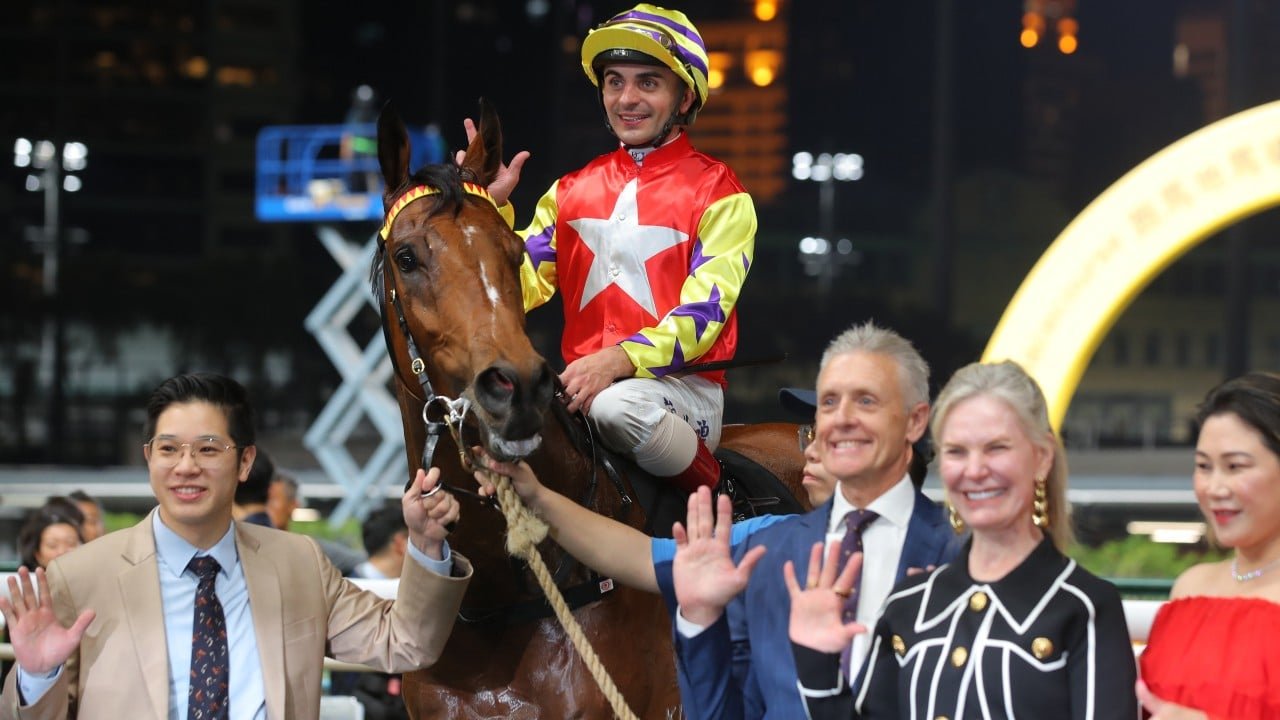
Mark Newnham celebrated a career-best five winners at Happy Valley on Wednesday night, while Andrea Atzeni continued his red-hot form with his second four-timer in as many weeks. Newnham jumped back up to second in the trainers’ championship on 40 wins after falling just one win short of current title leader Caspar Fownes’ record of six winners at a Hong Kong meeting, which he achieved at the Valley in 2010. While Newnham trained four winners on a day in Australia across different tracks, it was...View the full article

-
Six Speedy Females of the Week for Mar. 9 -16
Wandering Eyes posted a topic in The Rest of the World
6. NEXT GIRL, CNL, 3/12, Allowance, 1 1-16 miles (video) Beyer Speed Figure-91 (m, 5, by Divining Rod–Fleet and Fancy, by Touch Gold) O-WWCD. B-Country Life Farm and Fleet and Fancy (Md). T-W. Robert Bailes. J-Jeiron Barbosa. WWCD partners Konrad Wayson and Wade Meadows bought Next Girl as a weanling for $20,000 and have campaigned her through 28 starts and 8 wins, with this 3 1/2-length allowance romp as the high point. Her two best races have come on wet footing, but she'll surely never again encounter conditions like she saw Thursday at Colonial: heavy snow obscured the field from the start until she emerged with a six-length lead in upper stretch. 5. PASSAGE EAST, CNL, 3/14, Sandy Bottom Stakes, 1 mile (video) Beyer Speed Figure- 93 (3rd) (f, 4, by Audible–Salten Sapity, by Congrats) O-Larry E. Rabold. B-Don Alberto Corporation (Ky). T-Hugh McMahon. J-Sheldon Russell. She wasn't left at the gate but did herself no favors with a slightly sluggish beginning that immediately had at the rear of the five-horse field and a couple lengths farther back than usual. In midstretch she looked like she might win, anyway, because that's what she does–she came into the Sandy Bottom with eight wins in her last nine starts–but then she couldn't quite match strides late with Chasten and Her Laugh (below). 4. HER LAUGH, CNL, 3/14, Sandy Bottom Stakes, 1 mile (video) Beyer Speed Figure-94 (2nd) (f, 4, by Practical Joke–Truth Goddess, by Point of Entry) O-Grantley Acres, Pantofel Stable, Wachtel Stable and Gary Barber. B-Grantley Acres (Ky). T-Riley Mott. J-John Velazquez. Her Laugh hasn't won since capturing the Untapable Stakes at Fair Grounds more than a year ago, and trainer Riley Mott conceded that lately he's been “throwing her to the wolves.” But she actually ran a winning race in defeat in an easier stakes spot at Colonial, racing much closer to the pace under John Velazquez and battling gamely with Chasten (below) only to come up a half-length shy. 3. GOODALL, OP, 3/14, Purple Martin Stakes, 6 furlongs (video) Beyer Speed Figure- 94 (f, 3, by Yaupon–Moon Over Mag Bay, by Malibu Moon) O-Spendthrift Farm. B-Mark Toothacre and Bill and Corinne Heiligbrodt (Ky). T-Steve Asmussen. J-Erik Asmussen. Goodall didn't monkey around in stamping herself as a horse to watch in the 3-year-old filly sprint division with this emphatic 4 1/2-length score over odds-on River Wind, herself a promising talent. Yaupon is an ascending young sire, and while dam Moon Over Mag Bay was a lousy racehorse, her pedigree page may soon get an upgrade: she's a half-sister to Cherokee Nation, the Bob Baffert trainee whose powerful maiden win makes him one of the favorites for the upcoming GI Santa Anita Derby. Mythical winning Gulfstream's Any Limit Stakes | Lauren King 2. MYTHICAL, GP, 3/14, Any Limit Stakes, 6 furlongs (video) Beyer Speed Figure- 94 (f, 3, by St Patrick's Day–Lailoni, by Brethren) O/B-Arindel (Fla). T-Jorge Delgado. J-Edgard Zayas. Last summer at Saratoga, then-unbeaten Mythical threw in a head-scratching clunker in the GI Spinaway Stakes but immediately bounced back with two stakes wins at Gulfstream. Then came another sluggish no-show in the Jan. 31 GIII Forward Gal. “I think she's going to bounce back again,” trainer Delgado said. And he was right: the Arindel homebred sped to a convincing two-length victory in a stakes-record 1:09.40 and career-high Beyer. The competition was softer, but she was also better. 1. CHASTEN, CNL, 3/14, Sandy Bottom Stakes, 1 mile (video) Beyer Speed Figure- 95 (f, 4, by Into Mischief–Lockdown, by First Defence) O/B-Juddmonte (Ky). T-Brad Cox. J-Cristian Torres. For a half-sister to two-time Eclipse champion Idiomatic by Into Mischief, Chasten had been an underachiever to this point. But does this leap to stakes winner and career-best 95 Beyer Speed Figure represent a step forward that can be sustained or will it be a one-off? At first glance the number seems surprising, since Chasten and runnerup Her Laugh (above) both improved sharply to new tops. But even over a lightning-fast Colonial strip, her mile in 1:33.40 warranted the figure –older stakes males the race before went in 1:33.57. The post Six Speedy Females of the Week for Mar. 9 -16 appeared first on TDN | Thoroughbred Daily News | Horse Racing News, Results and Video | Thoroughbred Breeding and Auctions. View the full article -
Christopher McKeever, the man responsible for last week's Champion Bumper hero The Mourne Rambler (Well Chosen), has spoken of his disbelief in the aftermath of the success that saw him join a select group of Cheltenham Festival-winning breeders, achieved with a horse trained by his great friend of 60 years, Noel Meade. “I was here at home with the dog, my wife and a friend of mine,” McKeever told TDN Europe on Tuesday, having watched the race not at Cheltenham but in County Meath, where he lives just a stone's throw away from Meade's Tu Va Stables. “I got two phone calls before he'd even pulled up and I had to go outside. I just couldn't believe it. I was amazed. To be honest, it's only sinking in now, but I do know that the whole parish and the local towns all backed him. Here, when you hit on a good horse like that, everybody owns him.” He continued, “I didn't back him because I don't gamble, although all breeders are gamblers and dreamers, really. We gamble to get the right foal and we dream of getting a Grade 1 winner. All breeders are the same and I'm no different from anybody else. I'm just very, very lucky. That's what I am. I'm extremely lucky and blessed to have a mare like Lobinstown Girl.” Lobinstown Girl, the dam of The Mourne Rambler, was also trained by Meade during a racing career which saw her fail to win in eight starts under Rules. She went close on her penultimate outing at Punchestown, however, before getting injured at Wexford a few weeks later to leave her syndicate of owners, including McKeever, in something of a quandary. “She ran in Punchestown and was second, so everybody was on a high, but then she ran at Wexford and got injured,” McKeever recalled, before revealing the modest sum it cost him to take outright ownership of the daughter of Luso. “Syndicates here can fall asunder very quickly when things are going bad, so I bought her from the syndicate and I gave them €350 for her. “I was a couple of months off retirement. I had another mare, Miss Audacious, whose progeny won races for Philip Hobbs and Alan Jones. I intended to have two mares as a hobby, just to give me something to do when I retired. I was always involved in horses, but I had drifted away for 20-25 years because it just wasn't paying me. There was no financial gain in it at all and I had mortgages and children and that kind of thing. The rest is history.” Even before The Mourne Rambler came on the scene with his maiden bumper win at Leopardstown on Boxing Day, Lobinstown Girl had proven her worth as a broodmare as the dam of three black-type performers from four runners. They included Sixshooter, who ran one of his best races when finishing third in the G2 Galmoy Hurdle, and G3 “Monksfield” Novice Hurdle runner-up She's A Star, the product of the first of many matings with Kedrah House Stud's Well Chosen. “My brother [point-to-point trainer Colin McKeever] had trained a horse by Well Chosen that had gone to Henrietta Knight. He suggested Well Chosen, so I rang Tom Meagher [of Kedrah House Stud] in 2011,” McKeever said of how he settled on Well Chosen for Lobinstown Girl's maiden cover. “I thought Tom was a straight-talking guy and he punched proper. I looked at Well Chosen and thought he was a smashing horse. To tell you the truth, he was in my price range at €800. That foal, She's A Star, came from an €800 stallion and a €350 mare!” He added, “I kept going back to Tom and Sixshooter is another full-brother [to The Mourne Rambler]. Noel bought him off me in November and She's A Star won her point-to-point then in February. Noel did tell me to hold on to him but, to be truthful with you, it wasn't feasible. There's no point saying otherwise, money was very tight. As a small breeder, it can be very much a struggle now. “Tom Meagher has been a huge, huge help to me over the years. There's a thing I have called loyalty. If I am treated right, then I will treat people right. Tom Meagher is one of the people that has been with me from the start. We both started from the very bottom, with Well Chosen and the mare, and look at what has happened.” At the age of 27, Well Chosen's stock has arguably never been higher given what happened at Cheltenham last week, with the success of The Mourne Rambler being his second at Grade 1 level in the space of two days, following that of Old Park Star in the previous afternoon's Supreme Novices' Hurdle. It's still early days, but Old Park Star is potentially the most exciting runner yet for a stallion who has done things the hard way. “Back at the time when Well Chosen bred She's A Star, he wasn't covering very many mares,” said McKeever. “Well Chosen does not breed commercial foals. That was his problem. He wasn't throwing sales horses, but he was throwing racehorses. He just wasn't what they wanted and I couldn't understand it because his record was fantastic. “They wouldn't have been fancy, good-looking horses but, by Christ, they could run. The Mourne Rambler is a good-looking horse, but he's not exceptional to look at. If you were going to give €100,000 for a horse, I don't think you'd have given it for him before he won.” The Mourne Rambler as a foal with Lobinstown Girl | Christopher McKeever The proof is in the pudding, with The Mourne Rambler by no means topping the bill on the two occasions that he was offered at public auction. He first changed hands for €32,000 when consigned as a foal by Kedrah House Stud, on behalf of McKeever, at the Tattersalls Ireland November NH Sale. “I sold him in Tattersalls and he ended up in Wexford,” said McKeever. “I didn't know where he went and I like to try and follow where they are. When they're in training, I probably bombard the trainers. I used to text Philip Hobbs and Alan Jones, as well as Lucinda Russell when she had runners that I'd bred. “Then, he came back to Goffs for the Arkle Sale where he didn't make a lot of money. I think he made €45,000 and I was amazed at that, to be honest. I thought he would make a lot more. But he was bought by a guy in the north who my brother would know well, Paddy Turley. Paddy is a very, very shrewd operator, a young man with a great future. “So, he was with Paddy and it was amazing how he went to Wexford, to the north, and then back down to us at home here – he went round the block! I don't mean this in a disrespectful way but, if he'd gone to Willie Mullins, or some other trainer down the country, or to the UK, I probably wouldn't even see him again. But I was down there with him on Saturday morning and it's just an amazing story. I really have to say it is now. I'm still on cloud nine.” A near-three-length winner at Cheltenham in the hands of leading Flat pilot Colin Keane, The Mourne Rambler was sporting the red and black silks there of Philip Polly, a neighbour of Turley's in Downpatrick, County Down. Turley had saddled the gelding to finish second in a point-to-point at Portrush in October last year, before Meade then sent out the 8/1 chance to win his bumper by over three lengths at Leopardstown. “I'd been getting all of the right vibes from Paddy Turley, but Willie can win a bumper by 25 lengths and you'd be up against a Grade 1 horse,” said McKeever. “Noel would always tell you that he was a good horse, but we didn't really know what we had. “The ground drying out [at Cheltenham] was a huge help to our lad. She's A Star won on the Flat at Dundalk and was second at the Curragh to a horse of Aidan [O'Brien]'s. She had a right bit of toe, but not as much as this guy. I'm not saying that it will happen, but I would imagine that Noel may run him on the Flat at some stage. I don't tell Noel what to do with any horse. I have horses in training with him and I leave it all to Noel Meade.” He added of their friendship, “We go back 60 years together. We hunted together and shared ponies as children. [Gold Cup and Grand National-winning jockey] John Burke, Noel Meade, James Halpin, my brother and myself, we were the crew that went round together.” Fittingly, Meade has trained each and every one of Lobinstown Girl's progeny to have made it to the racecourse thus far, with the promise of more to come from a mare who is said to be still going strong at the age of 21. Indeed, Meade has already taken charge of the four-year-old Islria, again by Well Chosen and subject to positive reports from McKeever, with a debut run looming on the horizon. “I think he is a stronger horse [than The Mourne Rambler],” McKeever said of Islria. “He's a very different model, a chestnut like Sixshooter and a big, strong horse. I had him in training with Noel last year as a three-year-old. Noel then had a client call me and I sold him in February. He's a cracking horse and I think he'll run in the near future.” He continued, “I still have She's A Star and she's in foal to Poet's Word. She's only about 15hh, but she won five races and finished second in the Grade 3 in Navan. She's already bred Colcannon. I'm not down as the breeder, but I bred him as well and he's a Grade 2 winner. “Lobinstown Girl is in great order as well. You wouldn't think she was 21 now. She slipped her foal this year, unfortunately. I want to get her checked out with the vets and, if they're happy, she'll go to Rich History [at Kedrah House]. She started with Tom and she'll finish with Tom.” Whenever that story should end, it will certainly have been quite the journey for the McKeever family, the long and winding road which led them to their crowning achievement at Cheltenham last week, courtesy of the foal dubbed 'Pfizer' when he was born in April 2021 at the height of the Covid-19 pandemic. “Should I give up now when I'm in front?” joked McKeever, still very much savouring the moment. “Actually, a friend of mine said to me yesterday, 'What the hell would you give up for? You need to go for the Melbourne Cup!' It's like I said to you earlier, breeders are dreamers and gamblers. That's the bottom line. None of us make a fortune out of it, particularly in National Hunt, but the fulfilment I've had is just amazing. I can't put it into words. If it works out, it's great, but it's a lonesome road if it doesn't. “Listen, it's been a wonderful, wonderful journey. I never would have expected it, because I've had my own issues as well, health issues and things like that over the past few years. It's just been a huge, huge lift. Everybody around me seems to be so happy and it's just a wonderful story. I just can't believe at times that it happened to me, but it has.” The post ‘I’m Still On Cloud Nine’ – McKeever Riding High with Cheltenham Hero The Mourne Rambler appeared first on TDN | Thoroughbred Daily News | Horse Racing News, Results and Video | Thoroughbred Breeding and Auctions. View the full article
-
The 129th season of racing returns to Fort Erie Race Track this summer, with Thoroughbred action running from May 31 through Oct. 20.View the full article
-
Stepping into the shedrow of Laurel Park's Barn 22 late in the morning on a dark day, all is relatively quiet. Outside of the office, a groom rakes up loose pieces of straw as the horse residing in the first stall peers out inquisitively, all the while his neighbor to the left lies curled up in freshly tossed bedding. Further down, a wheelbarrow sits parked outside of the fifth stall, which is where you'll find trainer Henry Walters as he finishes mucking out. After setting aside the pitchfork and giving his trainee a pat on the neck, Walters re-clips the webbing and carries on down the aisle. The hands-on routine is one that has long been second nature to Walters, a Maryland native who has trained horses in his home state for the last four decades. A career turned life's work fueled by a deep-rooted passion for the horse, it was all inspired by Walters's father, Charles. “It all began with my dad. He started owning racehorses sometime in the middle of the '60s, cheaper horses. Somewhere along the line, he wound up with three that needed some time off. While looking for a place to turn them out, he pulled up to a horse farm on the corner of Falls Mountain Road and Bel Air Road. The husband and wife came out and it just so happened that the man, either in his late 70s or early 80s at the time, was a retired trainer,” recalled Walters. “His name was August Rogan. He had been retired for about 10 years at that point but used to train horses on the half-mile circuit at tracks like Bel Air and Hagerstown. When my dad asked him about bringing the horses, the old man was all for it. That's how it started for us, my brothers and I.” One of nine children in his immediate family, Walters and his two brothers, John and David, were the trio to follow their father down the path in pursuit of what he considered life's greatest thrill: horse racing. Day in and day out, the three boys would venture out to Rogan's farm to learn everything firsthand from the industry veteran. Eventually, the horses were ready to return to the track and with them, Rogan came out of retirement to oversee their training. He was joined by the Walters boys, all making the transition from farm to the racetrack as grooms for their father's horses in the early 1970s. John was the first go out on his own as a trainer, followed by David and finally, Henry. Henry Walters spends time with Barbadian Runner | Sara Gordon “It was 1973. We were increasingly getting involved as we were all eyewitnesses to Secretariat winning the Triple Crown, with our enthusiasm for the sport getting bigger and bigger,” said Walters. “I bought a yearling that year and that horse turned out to be the reason behind my love for the game to this day. His name was Rainy Lane [Umbrella Fella] and he became a really good horse, a total speedball. He was the first horse I groomed and I was there to watch him win nearly 20 races for us. Eventually, we lost him in a claiming race in 1980, and that's when I decided to go out on my own. “I had my first winner in 1981 and I've been a hands-on guy ever since.” Throughout his decades-long career, Walters has never had more than 11 horses in the barn. It was in 1995 that he had his highest number of starts, totaling 95, followed by a career-high total of 17 wins nine years later in 2004. “I've never had any big owners come to me and say, 'Hey, I've got five or six horses that I want you to train.' But I'm proud to say I've made some pretty decent claims over the years, with a lot of them becoming either stakes winners or stakes-placed,” said Walters. The sale purchases have also left their mark under Walters's tutelage, led by Maryland-breds Tommy Shelby (Super Ninety Nine), a $2,000 yearling, and Addy's Laddy T N T (Golden Lad), a $9,000 yearling. Both were stakes-placed. Up until 2025, Tommy Shelby led as Walters's highest-earning trainee. That is, until Barbadian Runner (Barbados) came along. The story begins at the 2023 Fasig-Tipton Midlantic Fall Yearlings Sale. Walters and owner Scott Groh of AJ Will Win Stables, LLC had already been outbid on three or four yearlings before a dark bay Barbados colt out of Quiet Run (Northern Afleet) walked into the ring. Bred and offered by Shamrock Farm, the Maryland-bred colt came from a modest pedigree but showed enough physically to warrant a second look from the trainer-owner duo. When the hammer struck at $5,000, the colt was destined for Walters's barn. “There was nothing fancy about him. He'd come in, do his work, and he was always very forward in his training. When he started breezing as a young horse, I'd hook him up with one of mine or somebody else's, and he always held his own against them,” said Walters. “He was never a minute of trouble.” Debuting at Laurel as a 2-year-old in June of 2024, Barbadian Runner broke his maiden at second asking the following month. The young gelding finished on the board in six of his eight starts that season, highlighted by back-to-back third-place finishes in the Maryland Juvenile Stakes and Heft Stakes. “In the back of my mind, he was a closing sprinter. I never would have dreamt that he would go beyond seven-eighths of a mile because his dad couldn't,” said Walters. Barbadian Runner wins the 2025 Robert Hilton Memorial | Coady Media Heading right into stakes company as a 3-year-old, Barbadian Runner reeled off consecutive victories in the Spectacular Bid Stakes, going seven furlongs, and the Miracle Wood Stakes, where he made a successful step up to the mile distance. With the goal of testing his versatility further, Walters sent Barbadian Runner out to make his turf debut in the James W. Murphy Stakes on Preakness Day at Pimlico Race Course. The gelding finished a respectable fourth, marking the only time he'd finish out of the top three in his 12 starts that season. Barbadian Runner wheeled back two weeks later to dominate an off-the-turf edition of the Jersey Derby at Monmouth Park, followed by a trio of consecutive runner-up finishes in the Delaware Derby, the Star De Naskra Stakes and the Petramalo Mile Stakes that summer. Continuing his tour of the Mid-Atlantic circuit, the 3-year-old took his talents to Charles Town for the Robert Hilton Memorial Stakes, where he went on to best a field that included Kentucky Derby starters Owen Almighty (Speightstown) and Neoequos (Neolithic). “I always felt like my horse is really handy, he accelerates on the turns, so I thought, 'Why not give him a shot around those two turns?'” said Walters. “He caught a monster field, but under a beautiful ride from Forrest Boyce, he saved ground, swung out and just went about his business. That was a great win.” It was at that point that all focus turned to the Oct. 11 Maryland Million Classic, where the sophomore would take on older horses for the first time, including multiple graded stakes winner Post Time (Frosted). Though the Brittany Russell trainee may have been the more experienced of the two, it was Barbadian Runner that proved the ultimate talent that day as he geared down to best Post Time by three-quarters of a length. “Just crossing the finish line on Maryland Million Day was a great thrill, but the biggest thrill was when he came back to the winner's circle. The entire grandstand was hollering and clapping, almost like a Super Bowl moment. I didn't realize that many fans were into this horse. It was special,” said Walters. Barbadian Runner closed out his 2025 season with a victory in the Richard W. Small Stakes and a second-place finish in the Robert T. Manfuso Stakes. Among his 20 career starts, the Maryland-bred has proven to be the model of consistency, with 17 top-three finishes highlighted by six stakes victories—all won as a 3-year-old. The $5,000 yearling purchase has earned upwards of $810,000. Barbadian Runner wins the 2025 Maryland Million Classic | Jim McCue/TMJC His trainer's first stakes winner since 2004, Barbadian Runner now reigns as the most successful horse Walters has ever trained. “Usually, Barbadian Runner is the first horse trained in the morning and he's an easy one to work with. He is very playful but when he's on the racetrack, he's all business. Sometimes he wants to fool around a bit, making it feel like I didn't do enough with him that day, but if I trained him as hard as I thought he needed, he probably wouldn't be as good as he is,” said Walters. “He definitely has a personality. He's a candy freak, pawing in the corner of his stall as soon as I get here in the morning. I try to appease him.” Walters has yet to set any concrete plans for his stable star's upcoming season, though he did mention that the Mid-Atlantic circuit will remain the focus. In the meantime, Barbadian Runner has been enjoying a well-deserved winter break and will return to Laurel this month. Prior to his seasonal debut, the multiple stakes-winning Maryland-bred will be in the spotlight once again at the upcoming Maryland Thoroughbred Industry Renaissance Awards, celebrating Maryland's top equine athletes and connections from the 2025 season, which will be held Sunday, March 22. Barbadian Runner is a finalist for both Maryland-bred champion 3-year-old male and male dirt horse of the year. As for Walters, the Maryland trainer closed out 2025 with a record of 8-12-4 from 71 starts with season earnings totaling $859,670. To sum it up, his best season yet. When asked what keeps him going, Walters delivered a simple yet poignant response for a man now training into his 46th year. “I guess I just wouldn't know what else to do. It's the only thing I know to do, and as long as I'm physically able to do it, I'll do it as long as I can. I'll always have a passion for the game and the horses themselves.” The post ‘I’ll Do It As Long As I Can’: 46 Years And Counting For Maryland Trainer Henry Walters appeared first on TDN | Thoroughbred Daily News | Horse Racing News, Results and Video | Thoroughbred Breeding and Auctions. View the full article
-
Thoroughbred Aftercare Alliance will be on-site at Gulfstream Park for the GI Curlin Florida Derby on Saturday, Mar. 28. As part of Florida Derby Day, Thoroughbred Aftercare Alliance will be recognized with a named race on the undercard. After the race, the winning connections will be presented with a Thoroughbred Aftercare Alliance branded blanket and commemorative gift bag. A Thoroughbred Aftercare Alliance representative will be on-site to host the winners of the “Off to the Races” VIP Experience online benefit auction. Donated by 1/ST RACING, the Florida Derby Day VIP Experience includes dining for four at Ten Palms Restaurant, trackside breakfast, a guided backside tour, betting vouchers, paddock access, swag bags, and a behind-the-scenes opportunity to watch Peter Aiello call an undercard race from the announcer's booth. “The continued support of partners like 1/ST and Gulfstream Park helps make our work possible,” said Stacie Clark Rogers, Operations Consultant, Thoroughbred Aftercare Alliance. “We're excited to be part of Florida Derby festivities and to share our mission with the racing community during these outstanding events.” The post Thoroughbred Aftercare Alliance On-Site at Florida Derby appeared first on TDN | Thoroughbred Daily News | Horse Racing News, Results and Video | Thoroughbred Breeding and Auctions. View the full article
-
Flavien Prat's dominant five-win performance at Colonial Downs—highlighted by victories in the Virginia Oaks, Royal New Kent, and Sandy Bottom Stakes earned him Jockey of the Week honors for March 9-15.View the full article