
-
Posts
486,625 -
Joined
-
Last visited
-
Days Won
719
Content Type
Profiles
Forums
Articles
Videos of the Month
Major Race Contenders
Blogs
Store
Gallery
Everything posted by Chief Stipe
-
Really? Since you are an expert on Geo-politics and Global Oil Demand and Supply answer this question. Why is the Brent Crude Oil barrell price the same as it was between 2011 and 2014 yet the price at the pump is double in March 2026? Iran have no option but to make a deal. What I don't get is why the hell are you supporting Iran?
-
Take your doom misery glass half empty lenses off for a moment. You said it was a very bad thing and would COST Qatar $100 billion over 5 years. I said it would cost them anything as the gas would remain in the ground. You should looked at it in another way - it is deferred revenue. BTW Qatar has $125 billion in foreign reserves so should be able to weather a storm for a few months. That's nonsensical - but in any case they've cut it down to zero BTW. Again it is deferred revenue. The 83% of the LNG supply chain not damaged can be bought back online in 2-3 weeks. Not at all - I was looking at logic and reality in a positive light - you may wish to try it. From a global perspective OPEC has been manipulating Supply and Pricing since 1960. Qatar supplied 20% of the world production of LNG and mainly exported it to China and India. To fill the market demand other countries have stepped up their production e.g. Australia. Subseqently the LNG price is back down to the 5 year average. Guess what will happen when Qatar comes back online? The other countries will wind back production as unlike Qatar they have a lot less gas under the ground and will not want to force the price of gas downwards.
-
It doesn't COST Qatar anything to not be able to sell what remains in the ground. Demand will only increase, the price will rise and the gas doesn't decay. Meanwhile the 83% of their gas still able to be sold will increas in value.
-
Geez @the galah what relevance does an expert in tank warfare have today? Seriously unless Russia or China pitch in Iran has nothing left. I favour the Saudi Arabia plan - nail Iran now.
-
Iran's Navy According to March 2026 reports from U.S. Central Command, the U.S. has destroyed or damaged over 90% of Iran's major naval vessels and significant portions of their naval infrastructure, effectively neutralizing their conventional maritime capabilities. While major surface combatants and submarines are largely sunk or disabled, Iran's decentralized "mosquito fleet" of small attack boats and shore-based missile threats remain a dangerous, though degraded, threat. Key details regarding the status of Iran's navy include: Significant Losses: More than 140 Iranian naval vessels have been sunk, and over 90% of their largest, most capable ships are destroyed. Submarine Fleet Disabled: Reports indicate Iran's primary submarines, including its Kilo-class and many Ghadir-class "midget" submarines, are likely non-operational or destroyed. Major Assets Destroyed: Key ships, including the IRIS Dena warship and the Shahid Bagheri drone carrier, have been sunk or damaged, according to RFE/RL and 19FortyFive. Infrastructure Damaged: More than two-thirds of Iran’s naval production facilities and shipyards were damaged or destroyed in the strikes. Remaining Threats: The IRGC (Islamic Revolutionary Guard Corps) retains a portion of its small-boat swarm, and shore-based anti-ship missiles and mines still pose a risk to the Strait of Hormuz. The conflict has largely destroyed Iran's ability to engage in conventional naval warfare, leaving only fragmented, asymmetric capabilities.

-
Irans Airforce As of late March 2026, Iran’s air force is considered largely destroyed or minimally functional following intense conflict with US and Israeli forces, with many of its aging, pre-1979 aircraft lost on the ground or shot down. While theoretically boasting hundreds of older jets, only a few are considered operational. Current State of Iranian Air Power (March 2026): Minimal Operability: Reports indicate the air force is "no more" or, at best, "minimally functional," with severe losses to its already outdated fleet, says NPR. Key Losses: Israel reportedly destroyed F-4 and F-5 jets at Tabriz, along with F-14s during Operation Midnight Hammer, and Qatar reported shooting down two Iranian Su-24s, according to the National Review. System Failure: Decades of sanctions, lack of parts, and inability to modernise forced a reliance on an antique fleet, which proved incapable of defending against advanced modern aircraft, says Forbes. Inventory Context: While a 2025 inventory listed roughly 300+ aircraft—including F-4s, F-5s, F-14s, MiG-29s, and Su-24s—these were long considered difficult to maintain and largely outclassed, says AeroTime.
-
I asked for your verifiable source of this information. I'm sure @Newmarket can help you out.
-
So how any planes does Iran have left flying? How any navy boats still floating? Tinnies don't count.
-
Where did you get that BS from?
-
Where did you get that figure from?
-

You have to wonder what Trentham's priorities are.
Chief Stipe replied to Chief Stipe's topic in Galloping Chat
I'm not sure what evidence you have to class it as "one of our best tracks". It has dodged bullets for a while now. Last Saturday it was a "Soft 5" and running better times than Riccarton Good 3. Explain that? -
You have to wonder what Trentham's priorities are.
Chief Stipe replied to Chief Stipe's topic in Galloping Chat
Trentham stabling area has been a disaster and hazard for the past 20 years that I've had reason to be there. -
No @curious you are becoming funny in a tedious way. Your negativity knows no bounds - you are even commenting on Standardbreds now.
-
Overnight Travel Barns at Awapuni Due to a reshuffle of barns at Awapuni can overnight travellers use the old overnight barns that are located next to the machine compound. Any issues or queries please contact Daniel Amies – 021 278 1951 STABLING RESTRICTIONS Due to space restrictions there is NO opportunity for trainers to bring “companion” horses to Trentham this Saturday.
-
Half on personnel expenses, half on supplier expenses. All the detail is in the Annual Report. Note most of the funding comes via TAB NZ from Pokie revenue. RIB-Annual-Report-2025.pdf
-
Confidence Returns: New Zealand Records Largest Breeding Increase in 16 Seasons www.thebreeders.co.nz The 2025/26 season represents the largest increase in individual mares served in 16 seasons and just the third year on year lift recorded since 2009/10. The 2025/26 breeding season closed with 1670 individual mares served, up from 1571 the previous season. That is an increase of 99 mares, or 6.3 percent. Total services, which includes mares covered more than once, rose from 1675 to 1785, a lift of 110 services or 6.6 percent. On paper it is a modest rise. In context it is significant.https://bitofayarn.com While there have been isolated increases since 2009/10, including lifts of 21 mares in 2017/18 and 58 mares in 2021/22, the broader trend over the past decade and a half has been one of sustained contraction. Each year the base narrowed. Each year the conversation centred on contraction, ageing breeders, tightening economics and a racing environment that was not providing enough certainty to justify risk. While the trend has not been unique to New Zealand, the domestic drop had been pronounced and difficult to arrest. https://bitofayarn.com At the outset of this season, the shared position between Harness Racing New Zealand and the New Zealand Standardbred Breeders’ Association was not framed around rapid expansion. The focus was stabilisation. Arrest the decline first, then reassess what was realistically achievable. On that measure, this season represents tangible progress. https://bitofayarn.com The lift has occurred alongside a deliberate restructuring of incentives and renewed investment into the racing product. Stakes growth under the Entain agreement, programming adjustments and a clearer strategic direction at governance level have provided the platform. Breeding specific initiatives have reinforced it. The number of mares served by Harness 5000 eligible stallions rose from 580 to 811, an increase of 231 mares or 39.8 percent. That movement is material. It reflects a direct response to incentive alignment and pricing thresholds, with several stallions either entering the market under the scheme or repositioning their service fees to meet eligibility. Based on the fee adjustments and the number of mares served, breeders collectively saved in excess of $250,000 in service costs this season alone. https://bitofayarn.com The Fillies and Mares Credit Scheme, Harness 5000 and Paddock to Podium were introduced to strengthen breeder confidence and improve retention within the domestic system. The uptake indicates those settings are having the intended effect. HRNZ Racing and Wagering Manager Matthew Peden views the increase as evidence that the strategic alignment is beginning to translate. “We’re seeing the early dividends of a very clear industry focus. Stabilise the mare base, strengthen incentives, and create genuine opportunity. A six percent lift is a positive and meaningful shift. “The combination of financial initiatives like the Fillies and Mares Credit Scheme alongside programmes such as Harness 5000 and Paddock to Podium has helped rebuild confidence. https://bitofayarn.com “Importantly, the enhanced elite opportunities for fillies and mares are creating greater long term retention within our system, which supports both racing depth and breeding sustainability.” From an executive standpoint, HRNZ Chief Executive Brad Steele was equally measured. “To record growth in mares bred to after decades of sustained decline is significant. It signals early renewed confidence from breeders and owners, and reflects the collective work being done across stakes investment, targeted breeding incentives, industry engagement, and long term strategic planning. https://bitofayarn.com “While a single year does not reverse long term trends on its own, it is an important turning point. “We are grateful to our breeders for backing the industry and for their continued commitment to quality and performance. This uplift gives us momentum, but we remain committed to disciplined growth and structural reform to ensure the gains are sustained.” The pacing market accounted for the bulk of the overall lift, rising from 1160 mares to 1239, an increase of 79 mares or 6.8 percent. The growth was not evenly spread, but it was commercially logical. Downbytheseaside was the clear headline act. Off the back of an outstanding 2025 racing season in which he was the leading sire of individual Group One juvenile winners, he topped the pacing list with 196 mares. That represented an increase of 122 on the previous season. It was not speculative support. It was performance driven as results across the Tasman and in North America further solidified his reputation. https://bitofayarn.com King Of Swing provided one of the clearest examples of how pricing structure and incentive alignment can directly influence behaviour. His service fee was reduced from $6,500 to $5,000 to meet Harness 5000 eligibility, and his book lifted from eight mares to 48 in 2025/26. The Breckon Farms bred son of Rocknroll Hanover has since received solid backing through the 2026 NZB Standardbred Sales, and the early racetrack encouragement provided by the Bob Butt trained Fanfare has added to that confidence. Perfect Sting was the only other pacing stallion to record a double figure increase in mares served. His lift reflected strong early results from his first North American crop and the reshaping of the local market following the absence of Always B Miki from this season’s roster due to injury. https://bitofayarn.com US Captain, now based in partnership between Macca Lodge and Wai Eyre Farm, served 94 mares in his first season from his new New Zealand base. The son of Captaintreacherous was also Harness 5000 eligible, reinforcing the appeal of internationally credentialed bloodlines within an incentivised structure. Bettor’s Delight continued to demonstrate that class and longevity remain powerful currencies. The stallion widely referred to as “The King” served 65 mares. Now permanently based at Woodlands Stud and no longer undertaking annual shuttle duties to North America, the 28 year old continues to produce at the highest level while operating on a managed scale. The trotting market told its own story. For what is believed to be the first time, more trotting stallions were patronised than pacing stallions, with 34 trotting sires used compared to 30 pacers. Oscar Bonavena emerged as the standout. The son of Majestic Son served 52 mares in 2025/26, up from 20 the previous season, becoming just the second New Zealand bred trotting stallion in the modern era, alongside Royal Aspirations, to top his gait’s service list. The achievement is notable in its own right, and is further underlined by his continued elite level racing performances. His victory in the Banks Peninsula Trotting Cup during the season provided a timely and high profile endorsement of his credentials at stud, reinforcing confidence among breeders considering him. EL Titan recorded the largest year on year increase, rising from three mares to 38. Nevele R Stud’s Marcoola increased by 15 mares, while Father Patrick lifted by 10 after his service fee was adjusted to meet the Harness 5000 threshold. Across both gaits, the growth followed clear signals. Stallion performance, service fee positioning and incentive alignment all played their part. From a breeders’ perspective, confidence has always been closely tied to the strength and viability of the racing environment. “At the outset of the 2025/26 breeding season, the shared goal with Harness Racing New Zealand was stabilisation, given the eight preceding seasons had all recorded declining mare numbers,” said Brad Reid. “While that trend has been experienced across almost all global jurisdictions, ours has been sharp and has proven difficult to address for a range of reasons. https://bitofayarn.com “We know from years of survey feedback that the single biggest driver of breeding confidence is a healthy and sustainable racing product. With the investment of Entain and the strategic decision making of the HRNZ board and senior management, it’s fair to say our racing product is the strongest it has been for many decades. “When that is combined with significant direct investment into the breeding sector at levels not previously seen in this country, it gave me confidence that stabilisation was an achievable goal. We have worked closely with HRNZ as their breeding delivery partner to improve and address areas within our control, and I think we can both take some satisfaction from seeing an increase on the back of that work. “As Brad Steele has noted, one year does not undo decades of decline, but it does demonstrate what can be achieved when investment and strategy align with genuine effort. The response from across the industry has been instrumental. “The task now is to build on this foundation and, where appropriate, accelerate that growth. I don’t see that as unrealistic, particularly with initiatives such as Paddock to Podium, where returns to breeders have only begun flowing from 1 January this year. There is still upside in that programme alone. “At the same time, our strategic repositioning as a Kindred Body has delivered tangible outcomes, including increased membership and record event attendance. Engagement at breeder level is strengthening. We certainly won’t be standing still,” said Reid. Since the 2009/10 season, when mare numbers increased by 104, there have been only three year on year lifts, those being 2017/18, 2021/22 and now 2025/26. That lift is built on breeder commitment. Many have continued investing through uncertainty, backing the long term future of the industry through challenging cycles. The obligation now is to continue strengthening the structures that support those decisions and to ensure that the foals being bred today are met with depth, viability and opportunity in the years ahead. Editor’s note: An earlier version of this release stated that the 2025/26 season represented the first year on year increase in mares served in eight seasons. While the broader trend has been one of sustained decline, there was a modest increase recorded in 2021/22. The article has been updated to reflect this.
-
You've seen the head on. But you were too busy counting flank whip strikes for the @Comic Dog.
-
It's working. Think again. No they're not. They are in the process of capitulating. They will have to head to the negotiation table and now agree to the US demands for them to give up the enriched uranium. Meanwhile 5,000+ US troops are ready to be deployed. If you were taking a balanced approach and reading more than one or two news sources as well as putting your confirmation bias to one side you might actually grasp what is happening. Iran's military response is weakening rapidly.
-
Trump is the expert of the double bluff. Signs are that Iran is weakening and threats of an escalation are diminishing hourly. Iran knows if the US strikes the power plants they are finished.
-
Last 400m side on view.
-
I do find it amusing how social media is tribal to the extent that it causes people to take positions that if they were thinking rationally and logically they wouldn't take. Zac Lloyd was reprimanded by the Stewards for his interference of Fireball which is fairly close to getting suspended. As I said he was lucky that JMac was riding Fireball and his skill mitigated the damage. Just my opinion. I wonder how the bloodstock valuer is getting on with removing their purchase from the embargoed list. @Comic Dog
-
You really need to engage your brain occasionally. Brent Crude per barrell was $148 in 2008. In todays dollars thats $230. Did the world end in 2008 or was I lucky?
-
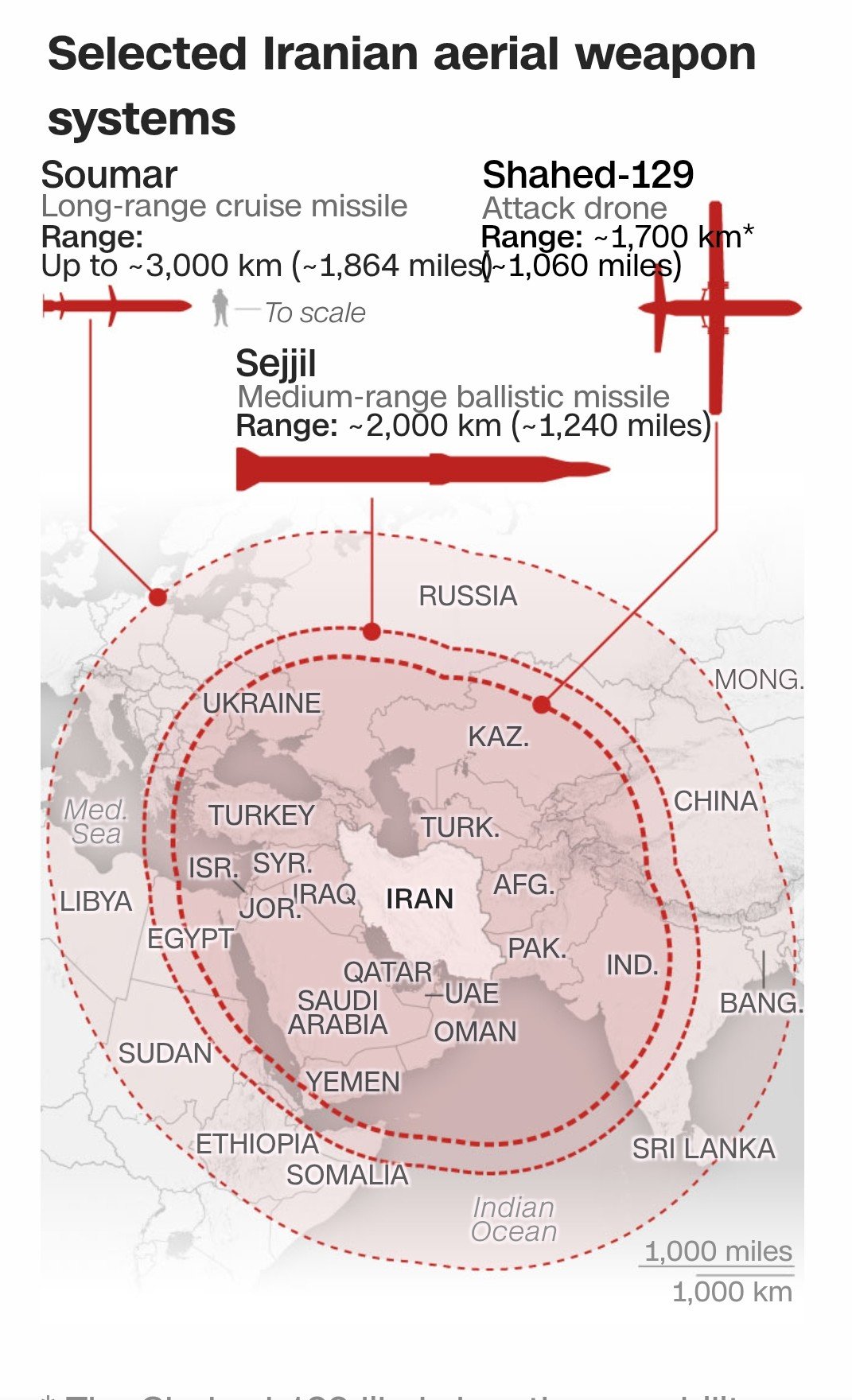
Which shows you how unhinged the Iran leadership is. A bit glib to call them "talking points". More like confirmation of Israel's and the USA's concerns. That map comes from your favoured news source CNN. They are only having trouble because the USA are intercepting them not because Iran is inaccurate. Imagine one with a nuclear war head or even a dirty bomb - intercepting those would have a far different outcome.
-
No he said they have obliterated their airforce and navy. That's a fact. Taking a bit longer to obliterate their missile stock. But I imagine that nuance escapes you.
-
Yes that man was the Ayatollah. NATO and other countries may be rethinking sitting on the sidelines.